
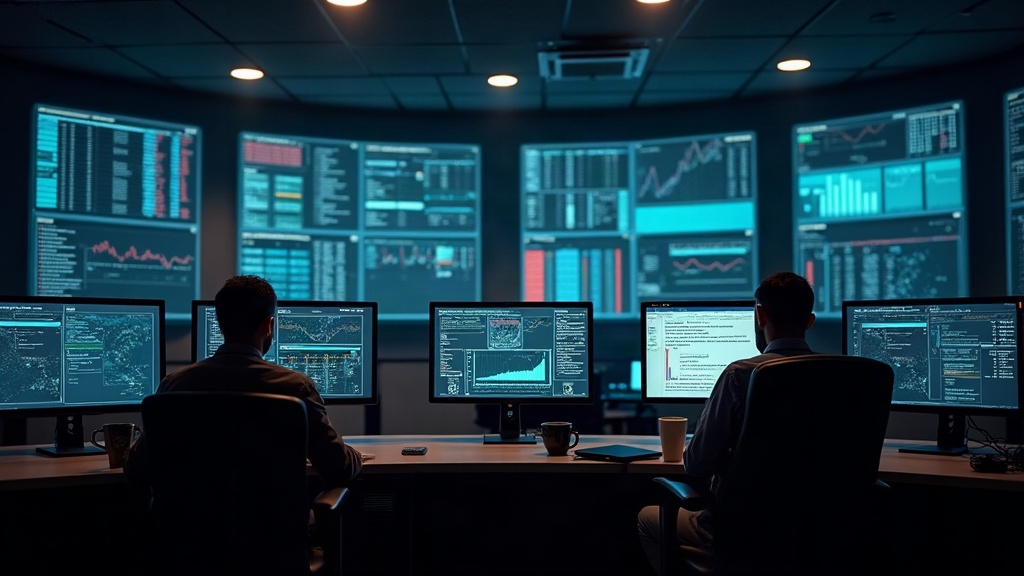
Attackers do not keep business hours. Ransomware deployments, credential stuffing campaigns, and lateral movement inside a compromised network happen at 2 a.m. on a Saturday as often as they happen on a Tuesday afternoon. If your organization’s security monitoring stops when your IT staff goes home, you have a gap that sophisticated threat actors are counting on.
For company owners, presidents, and CIOs evaluating their security posture, the question is not whether a 24/7 Security Operations Center (SOC) sounds impressive. The question is whether your current setup can actually detect and contain a threat before it becomes a business-ending event.
What a SOC Actually Does
A SOC is not a dashboard someone glances at once a day. A functioning SOC is a continuous operation staffed by analysts who monitor telemetry from your endpoints, network, identity systems, and cloud environments around the clock. When something anomalous surfaces, analysts investigate it in real time, determine whether it is a genuine threat, and take action or escalate before damage spreads.
The core functions include:
- Alert triage: Separating real threats from noise. Modern environments generate enormous volumes of security events. Trained analysts apply context to determine what actually warrants a response.
- Threat hunting: Proactively searching for indicators of compromise that automated tools have not flagged. This is where skilled analysts earn their keep.
- Incident response coordination: When a confirmed incident occurs, the SOC drives containment, isolation, and remediation steps in real time.
- Log and telemetry correlation: Connecting events across multiple systems to identify attack patterns that no single tool would catch in isolation.
Without continuous human oversight, your security tools generate alerts that sit unread until morning. By then, an attacker may have already moved laterally, exfiltrated data, or staged a ransomware payload.
Why Business-Hours Monitoring Is Not Enough
Many small and midsize organizations rely on an internal IT team or a part-time managed service provider to handle security. That team may be competent and well-intentioned, but if they are not monitoring your environment at 11 p.m. on a Friday, you are exposed.
Consider what happens during a typical after-hours intrusion. An attacker gains initial access through a phishing email or an exposed credential. They spend hours moving quietly through the environment, escalating privileges and identifying high-value targets. By the time your team arrives Monday morning, the damage is done.
A 24/7 SOC closes that window. Analysts see the anomalous login, the unusual process execution, or the unexpected outbound connection as it happens, not hours later.
Build vs. Buy: The Honest Tradeoff
Building an internal SOC is a significant investment. You need analysts across multiple shifts, a SIEM platform, endpoint detection and response (EDR) tooling, threat intelligence feeds, and the management layer to tie it all together. For most small and midsize businesses, that is not a realistic budget line.
The practical alternative is a managed SOC, sometimes called a SOC-as-a-Service or MDR (Managed Detection and Response). A reputable managed SOC provider gives you:
- Continuous monitoring without the overhead of hiring and retaining a full analyst team
- Access to threat intelligence and tooling that would be cost-prohibitive to license independently
- Defined escalation paths so that when something real happens, the right people are notified immediately
- Documentation and reporting that supports compliance requirements
The key is vetting the provider carefully. Ask specifically how alerts are handled after hours, what the escalation process looks like, and what your contractual response time commitments are. Vague answers to those questions are a red flag.
What to Look for When Evaluating SOC Coverage
Whether you are assessing an existing provider or evaluating new options, these are the questions that matter:
Coverage hours: Is monitoring truly 24/7/365, or does coverage thin out on nights and weekends? Get a straight answer.
Analyst quality: Are the people reviewing your alerts trained security analysts, or is the overnight shift handled by a junior technician following a script? The difference matters enormously when a real incident unfolds.
Tool integration: A SOC is only as good as the telemetry it receives. Confirm that your EDR, firewall, identity provider, and cloud environments are all feeding data into the monitoring platform.
Mean time to respond: Ask what the provider’s process is when a confirmed threat is identified. Who calls you, how fast, and what actions can they take on your behalf without waiting for your approval?
Compliance alignment: If your organization is subject to CMMC, NIST SP 800-171, HIPAA, or similar frameworks, your SOC provider needs to understand those requirements. Continuous monitoring is a specific control requirement under NIST SP 800-171, and your SOC documentation may be reviewed during an audit.
The Business Case for Owners and Executives
From a business leadership perspective, the case for 24/7 SOC coverage comes down to risk management. A security incident that goes undetected for hours or days is categorically more damaging than one that is caught and contained quickly. The difference between a contained incident and a full breach often comes down to how fast someone noticed and acted.
For defense contractors and supply chain organizations pursuing CMMC Level 2 certification, continuous monitoring is not optional. It is a documented control requirement. But even outside the compliance context, the operational risk of running without after-hours coverage is real and significant.
If you are not sure whether your current security setup includes genuine 24/7 SOC coverage, that uncertainty is itself an answer. Find out exactly what happens to your environment at midnight on a Sunday, and make your decisions from there.